Two posts in one day?
You guys sure are lucky...
Video test for production diary:
Showing posts with label cg. Show all posts
Showing posts with label cg. Show all posts
Monday, January 28, 2008

Monday, October 22, 2007
Hey Groove, Welcome Back!
So after much hiatus, I'm finally getting my groove back.
For many different reasons, at many different times, I couldn't bring myself to model anything. Pushing a poly was like pulling teeth, and I kinda just sat there, wishing I was as good as those in the field that I idolize for their incredible skills.
On Saturday morning, I had a conversation online with a peer who lives in Singapore and has taught me a lot over the past few years. He'll be teaching a CG class over there, and wanted to try his act on me a bit, covering different things. After his impromptu lesson, I was newly invigorated, and started modeling.
besides the picture to the right of this entry, I did some other cool stuff having to do with terrains and a major set for my story.
Once I can break out my laptop here at work, I'll transfer some pictures over to show.
It's been a while, and I'm glad I'm back.
For many different reasons, at many different times, I couldn't bring myself to model anything. Pushing a poly was like pulling teeth, and I kinda just sat there, wishing I was as good as those in the field that I idolize for their incredible skills.
On Saturday morning, I had a conversation online with a peer who lives in Singapore and has taught me a lot over the past few years. He'll be teaching a CG class over there, and wanted to try his act on me a bit, covering different things. After his impromptu lesson, I was newly invigorated, and started modeling.
besides the picture to the right of this entry, I did some other cool stuff having to do with terrains and a major set for my story.
Once I can break out my laptop here at work, I'll transfer some pictures over to show.
It's been a while, and I'm glad I'm back.
Tuesday, July 17, 2007
Making It All Work

3D art is not easy.
Putting together a single scene in 3D involves many different disciplines. As in many art forms, you first try to visualize what your end result should look like. This involves deciding the mood, the focus, the color scheme, the emotion and probably many other things I'm forgetting.

You build your models (which include principal actors or a focus), which involves an understanding of scale, spatial relationships, thinking in more than two dimensions, an attention to detail and understanding complex shapes.

Texturing objects involves understanding the physical properties of materials, how light reacts with an object, be it how color is affected, the mysteries of reflection, specular and gloss, light absorption, refraction, diffuse and other properties of light.
 Laying out a scene involves, orienting and placing each object,
as well as a main camera, in order to match as closely as possible what you originally visualized. Understand space and scale and how the eye works in general is critical.
 Lighting the scene takes into consideration not just your sun or moon,
but also the different properties of different man made light, as well as how light bounces of objects and in a sense, travels around your scene.
Animation, maybe the most popular of the disciplines, involves a strict understanding of natural motion, physics, acting, and concepts related to telling a story.
Each one of these steps is incredibly involved. Many books have been written by artists great and not so great, and many larger studios employ teams of people to handle each one of these stages.
I've somewhat wrapped my head around modeling, both hard-body and organic (although I could stand to get better), I understand the fundamentals of UV/Texture mapping, again, with much room for improvement.
However, there are the three other things that I'm still learning how to do.
Because of the fact that I haven't really attempted much animation, I'm saving that for last, but for the life of me, I can't figure out scene layout and lighting. I've bought books on lighting in the past, but most of it still alludes me.
Falloffs, intensity, the difference between the effect of an area light, an omni directional light, a linear light...
The difference between ray traced shadows and shadow map based shadows...
Global illumination, HDR imaging...
Then of course, there's layouts. What's the scale? How do you define scale in an image? What about the backdrop? How does the atmosphere and the time of day come into place?
I think that if i figure out the concepts behind all these things, maybe I can fly off this plateau that I've found myself grounded on for so long. I want to put things together, not just objects, but scenes. I want to put together little tiny bits of reality, one piece at a time. I want it to look damn good.
And I don't know what I'm doing wrong so far...
Thursday, May 31, 2007
The Apple Doesn't Fall Far
 APPLESEED was a joy to watch.
This is not news, as it's been out now for three years.
Not only was the story intriguing, but it was one of the first cel-shaded action movies from Japan to make waves in this country. Being a huge fan of cel-shading, this was a huge inspiration to me.
Appleseed, based on the graphic novel by the same name, was written by Masamune Shiro, and the graphic novel was so well received that it won the 1986 Seiun Award for Best Manga. Shiro, a fan icon inthe cyberpunk scene has gone on to pen many more stories, but for a large group of fans, Appleseed was a crowning achievement, followed only by the Ghost in the Shell series.
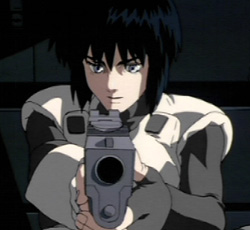 Two things come to mind when thinking about stories by Shiro; his frequent use of strong, female leads in his stories, and his philosophy on mecha and its limitations. For as much as I've seen, Shiro's stories have always had strong female leads, something which I admire. Let's face it, guy's and dolls, there are a lot of kick-ass women out there who hold their own just as much, if not more than men. Recently, there have been more heroine's in major media, Lara Croft, Ripley from the Aliens series, Battlestar Galactica's Starbuck and more that I'm sure I haven't mentioned. This is not to say that Shiro makes them larger than life necessarily, like so many male heroes have been, but he shows a determination and inner strength, as well as physical prowess that matches the boys. It's this fan's opinion that doing such was a great move by Shiro, as it not only set his work aside, but it finally gave the spotlight to those who deserve it.
Shiro once created a Rules of Mecha article a while back detailing the physical limitations of mechanical augmentations to the human body. Why is this significant? Well, in most movies, books and film, the artistic direction is completely implausible. Let's say you have Joe Action who loses both arms while fighting off a ferocious tribe of pygmy armadillos. Joe gets back and has bionic arms grafted to his body. Now he can lift up cars, steel vault doors and the like. Nope, sorry Joe, no dice. According to Shiro's articles, while the bionic arms themselves may have the capacity to lift an incredible amount of tonnage, they are still grafted to Joe's original bone structure. Due to the transfer of weight throughout the body, the shiny new arms would be fine, but the rest of poor Joe's bones would shatter. He's probably cry too... pansy.
Observations such as this changed the way that mecha (specifically human augmentation) has been designed. For example, all of the physical augmentations that deal with strength have been written to include fully reinforced skeletal structures.
 So why do I bring all of this up?
Because there's a sequal coming. It has been announced today that Appleseed Saga Ex Machina, the sequal to the first movie, is now in production and will be released Q4 07 in japan (so most likely Q1 08 stateside). From the trailer available on the official Appleseed Saga Ex Machina website, the technique and direction has significantly improved, as well as the quality of animation. Its being directed by the #1 fan of slow motion doves, Mr John Woo, so expect a good amount of gun-play and eye candy.
So am I excited? Oh hells yes. Not only does the fact that the series is continuing excite me, but seeing the cutting edge technique is something that I've been waiting for. Don't get me wrong, I like my share of ogres, donkeys, talking cats, talking, gingerbread men, talking penguins, talking toys, talking rats, surfing penguins, lost zoo animals, superheroes, talking mammoths and talking cars as much as the next red-blooded American, but I'm growing older now. My tastes have changed. I'm glad someone, somewhere has notices, and is making movies accordingly.
Subscribe to:
Posts (Atom)